
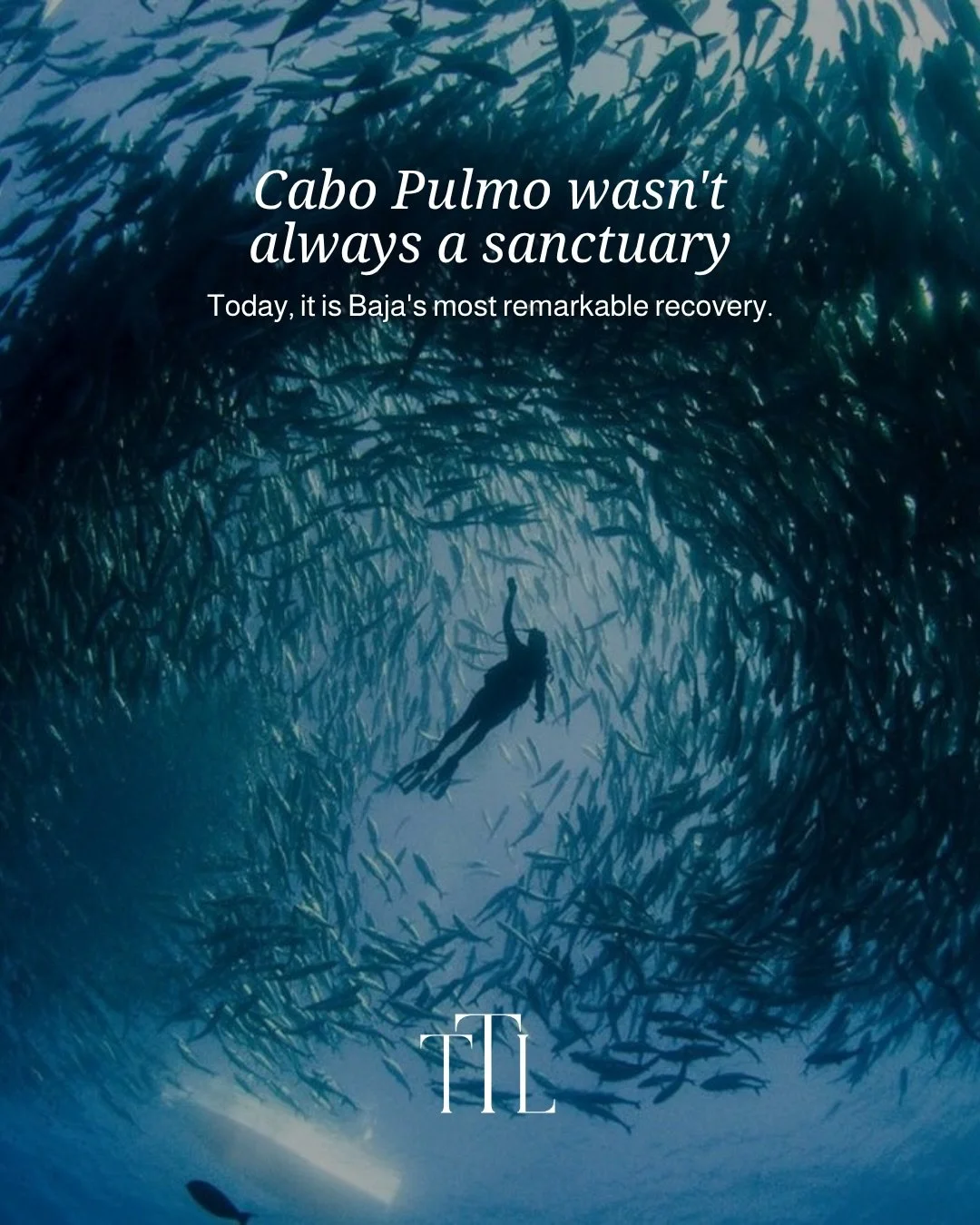
Some of the best things in Baja were not built. They were protected.
Cabo Pulmo sits on the East Cape, a long drive and a long way in spirit from the marinas of Cabo San Lucas. For generations it was a fishing village. In 1995, it made a quiet decision. The waters in front of it became a national park, and the fishing families who lived there backed it.
That is the part of the story that is easy to skip and should not be. A protected area on paper is one thing. A protected area supported by the people who used to fish it is another. In Cabo Pulmo, the people who had the most to lose in the short term chose the long term.
The numbers
The sea took its time, and then it answered.
Between 1999 and 2009, fish biomass inside Cabo Pulmo National Park grew 463 percent, from 0.75 to 4.24 tonnes per hectare. Top predators grew elevenfold. The study, led by Octavio Aburto-Oropeza and published in PLOS One in 2011, described it as the largest absolute recovery measured in a marine reserve worldwide.
The title of that study says it plainly: Large Recovery of Fish Biomass in a No-Take Marine Reserve. No-take means exactly what it sounds like. Inside the park, the fishing stopped. Everything that followed came from leaving the water alone.
Numbers like these are rare in conservation. Most news from the ocean moves in the other direction. Cabo Pulmo is the exception people point to when they want to show that protection works, and that it can work within a single generation.
Thirty years on
Three decades after the decision, the East Cape is changing around it. Aman's first resort in Mexico, Amanvari, opened at Cabo Pulmo on August 1, tucked into the cliffs, with architecture meant to disappear into the landscape.
That arrival says something about what the coast is now worth. It also raises the question every place like this eventually faces: how to welcome people without losing what brought them. The answer Cabo Pulmo gave in 1995 still holds. What is protected is what lasts.
Why it belongs here
We built The Twenty List around one idea: that the exceptional is limited, and that it is worth keeping. A home that cannot be recreated. A table that cannot be copied. And sometimes a stretch of sea that a small village decided not to spend.
Cabo Pulmo, one for the list.
Photo credits
Research: Octavio Aburto-Oropeza et al., PLOS One, 2011 (@octavioaburto)